3 Solution Overview
3.1 A modular, domain-driven design
A key design principle in the BPA Lab is modularity. The system aims for aspects of a Domain-Driven Design (DDD) approach so that:
- multiple students and developers can work in parallel on different parts of the system without stepping on each other’s toes,
- components can be reused in student projects to build new process applications,
- components can be replaced or upgraded independently.
The primary criterion for splitting job workers and process models is the business domain:
- Order management
- Manufacturing
- Shipping
- Purchasing
- Logistics / warehouse operations
This separation is inspired by the bounded contexts familiar from DDD and makes the system easier to reason about, both for teachers explaining it and for students extending it.
The DDD concept is not implemented to full extend, since the BPA Lab uses a central Business Process Management System instance (running separated processes communicated via messages) to orchestrate the entire process and a central database to ensure data persistence.
3.2 A simplified bird’s-eye view
The architecture and implementation of the BPA Lab are under continuous development. The following diagram shows the main components of the solution .
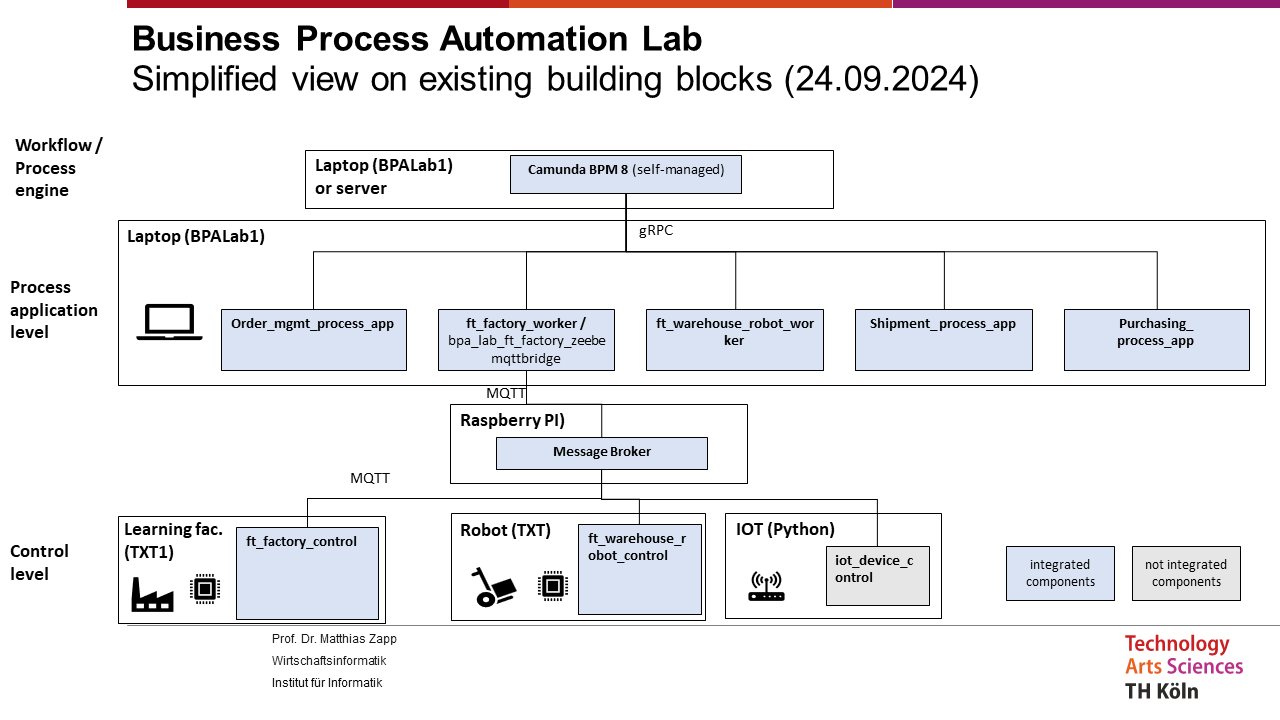
The customer-facing entry point is a user form (or web application) for order capture. From there, work flows downwards through Camunda 8 and the job workers and eventually reaches the physical Fischertechnik components. Events generated along the way flow back upwards and are persisted in databases for later analysis.
3.3 Three architectural layers
The solution is structured into three clearly separated layers.
3.3.1 Layer 1 — Controllers
Controllers are responsible for the direct control of hardware components: the Fischertechnik Industry 4.0 factory, the Fischertechnik warehouse robots, and IoT devices. They are predominantly implemented in Python and translate high-level commands (for example “transport workpiece from slot A to slot B”) into the low-level signals that move motors and read sensors.
3.3.2 Layer 2 — Process applications (job workers)
Process applications are middleware components that implement the actual business logic of individual work steps. In Camunda 8 terms, they are job workers: they subscribe to specific service tasks and execute them when activated by the workflow engine.
Job workers communicate:
- with the workflow engine via Rest or gRPC APIs,
- with the controllers via MQTT (a lightweight publish-subscribe protocol that is well established in the IoT space).
Process applications are predominantly implemented in Java.
3.3.3 Layer 3 — BPMS workflow engine
The central workflow engine is Camunda 8 (self-managed). It executes:
- BPMN process models — describing how work flows through the system,
- DMN decision models — encoding business rules.
Camunda 8 maintains the state of each running process instance, handles incidents, and provides the data foundation for process mining and analytics.
3.4 The demonstration factory implementation
The latest version of the BPA Lab as a runnable demonstration factory is available in a separate repository:
➡️ github.com/BpaLabTHCologne/bpa_lab_demonstration_factory
The implementation is fully containerised with Docker. This makes local setup straightforward and ensures that the environment is reproducible across different machines — a key requirement when students set up the system on their own laptops.
If you are setting up the BPA Lab for the first time, follow the installation guide in (Technical Instructions).